SNES
Illusion of Gaia
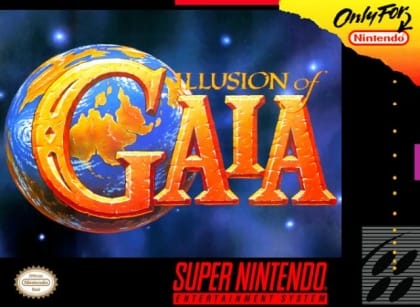
Illusion of Gaia is a 1993 action RPG developed by Quintet and published by Enix for the SNES. The game follows young hero Will as he travels the world discovering ancient ruins, developing psychic powers, and uncovering a cosmic mystery that threatens all life.
Share this game
Story
Setting Illusion of Gaia is set in a version of Earth that is partially historical but primarily fantasy -based. The game features several real-world locations, such as Incan ruins, the Nazca Lines , Angkor Wat , the Great Wall of China , and the Egyptian pyramids . Each of these ruins holds a piece of the final puzzle, which is revealed in the legendary Tower of Babel . The story takes place during the Age of Exploration, roughly corresponding to the 16th century, with references to figures like Christopher Columbus . Explorers seek ancient ruins, along with their treasures and secrets. Many return empty-handed, and some are never seen again. Will, the protagonist of the game, is the sole survivor of one such expedition. He accompanied his father, a renowned explorer, on a maritime journey to uncover the secrets of the Tower of Babel . The expedition encountered a mysterious disaster, and although Will managed to return to his hometown, he has no recollection of how he survived.
Gameplay Systems
While Illusion of Gaia features a large cast of characters, Will, Freedan, and Shadow are the only playable characters in the game. Each possesses unique abilities, and certain areas are inaccessible without a specific character. The characters acquire new techniques as part of the story progression. Will's techniques primarily focus on accessing new areas with incidental combat applications, while Freedan's techniques are more combat-oriented. Shadow joins the party later in the game. Combat is relatively straightforward. Characters share the same health and defense scores but have varying levels of strength. Freedan inflicts more damage than Will and has a longer reach, while Shadow deals more damage than Freedan. Attacks are primarily melee-based, utilizing Will's flute, Freedan's sword, or Shadow's pseudopod. Enemies' health bars are displayed upon attacking, appearing as a series of red spheres that represent hit points . Bosses cannot be revisited, and enemies reappear only when Will loses all his lives or exits an area and returns. Illusion of Gaia does not employ experience points ; instead, when the player defeats all enemies in a room, Will receives a jewel that grants a permanent increase in attack, defense, or health power. Although returning to a previously cleared area will cause enemies to reappear, the bonuses for defeating them again do not apply. When an enemy is defeated, it may drop a gold sphere worth a certain number of life points. If Will dies with 100 or more points, the player resumes play at the start of the current stage instead of losing outright. Illusion of Gaia lacks a currency or equipment system. There is only one healing item (herbs), which are scarce. Unlike most games of its type, previously visited areas cannot be revisited, except in the last third of the game. The only side quest, collecting all the Red Jewels, cannot be completed if the player fails to find some before advancing the story. Illusion of Gaia features a fixed difficulty setting. Saving occurs at Dark Spaces, which can be found in both combat and non-combat areas. Will can recover lost health within the Dark Spaces and may occasionally switch forms or gain abilities.
Media Reviews
IGN
74
Famitsu
8/10
Nintendo Power
3.675/5
Some information sourced from Wikipedia, available under CC BY-SA 3.0.