SNES
Super Mario World
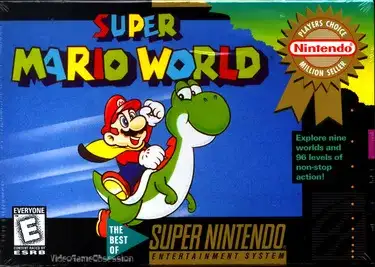
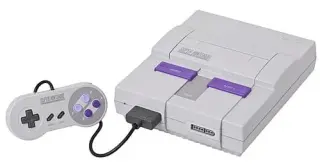
Super Mario World is a 1990 platform game developed by Nintendo EAD and published by Nintendo for the Super Nintendo Entertainment System. As a launch title for the SNES, it introduces Yoshi and expands the Mushroom Kingdom to the dinosaur-filled Dinosaur Land, where Mario and Luigi must rescue Princess Peach from Bowser and his Koopalings.
Share this game
Story
The plot of Super Mario World is detailed in the instruction booklet. After bringing peace to the Mushroom World in Super Mario Bros. 3 , the brothers Mario and Luigi decide to go on vacation with Princess Toadstool to a place called Dinosaur Land, a prehistoric-themed world swarming with dinosaurs and other enemies. While resting on the beach, the princess is captured by Bowser. When Mario and Luigi wake up, they try to find her and, after hours of searching, come across a giant egg in the forest. It suddenly hatches and out of it comes a young dinosaur named Yoshi, who tells them his dinosaur friends have also been imprisoned in eggs by Bowser's kids, the evil Koopalings. Mario and Luigi soon realise that Bowser's forces must have captured Toadstool as well. Mario, Luigi, and Yoshi set out to rescue the princess and Yoshi's dinosaur friends, traversing through Dinosaur Land for Bowser and his Koopalings. To aid him, Yoshi gives Mario a cape as they begin their journey. Bowser receives news of Mario and Luigi's approach and dispatches his Koopalings to dispose of them. After the brothers defeat the children and rescue Yoshi's friends, they eventually reach Bowser's Castle, where they fight him in a final battle. They send Bowser flying into the sky and save Princess Toadstool, restoring peace to Dinosaur Land.
Gameplay Systems
Super Mario World is a 2D side-scrolling platform game in which the player controls Mario or Luigi . The gameplay is similar to earlier games in the Super Mario but introduces new elements. As well as dashing and jumping, the player can also fly or float with the aid of the Cape Feather and P-Balloon and can execute the new Spin Jump move, which allows the player to crush enemies, bounce off normally-invulnerable ones safely or break certain blocks, with the latter only being possible if the player has a power-up active. There are 96 level exits in total. The player navigates via two screens: an overworld map and a side-scrolling course (some of which scroll automatically). The overworld map displays an overhead representation of the current world and has several paths leading from the world's entrance to a castle. Paths connect to action panels, fortresses, ghost houses, castles, and other map icons, allowing players to take different routes to reach the world's goal. Moving the on-screen character to an action panel or castle grants access to that course. The majority of the game takes place in 2D linear levels, populated with obstacles and enemies, which involves the player traversing the stage by dashing, jumping, and dodging or defeating enemies. The player is given a number of lives, which are lost if Mario comes into contact with an enemy while Small Mario, falls off the screen, gets crushed, touches lava, or runs out of time. The game ends when the player runs out of lives, although the player can continue from the most recent save point (a successfully completed castle, fortress or haunted house) by selecting " Continue ". Each world features a final stage with a boss to defeat; each of the seven worlds features fortresses controlled by one of the Koopalings , and the player also battles Bowser in his castle in the seventh and final world. Super Mario World includes a multiplayer option which allows two players to take turns at navigating the overworld map and accessing stage levels; the first player controls Mario, while the second player controls Luigi. In addition to the power-ups from previous games, such as the Super Mushroom and Fire Flower , Super Mario World has a new power-up, the Cape Feather, which gives Mario a cape and the ability to fly, glide in the air, and use the cape as a sail. It also introduces the ability to "store" an extra power-up in a box at the top centre of the screen. For example, if the player obtains a Fire Flower or a Cape Feather, then a Super Mushroom will appear in the box. Collecting a star grants Mario temporary invincibility from minor dangers. However, it does not protect the player from falling into lava or off the screen, nor if the player runs out of time. If Mario gets hit by an enemy, the stored item in the box will automatically drop. Alternatively, the player can manually release the stored item at any time. Super Mario World introduces Yoshi , a dinosaur companion Mario can ride who can eat most enemies. If Yoshi attempts to eat a Koopa or its shell, he can spit it out and fire it at enemies. If the player fails to spit the shell out within a certain amount of time, Yoshi will swallow it, rendering it useless. When holding any Koopa shell in his mouth, Yoshi gains the ability that corresponds to its color: a blue shell enables Yoshi to fly, a yellow shell causes him to emit dust clouds that defeat nearby enemies, and a red shell allows him to produce three fireballs that defeat enemies. Flashing Koopa shells produce all three abilities, while green shells produce none. The default Yoshi is green, but the game also has hidden blue, yellow, and red Yoshis; the player can obtain each colored Yoshi by finding its egg in the Star World areas and feeding it either five enemies, a Super Mushroom, a Fire Flower, a Cape Feather, or a Starman causing the baby Yoshi to mature. Although the main objective is to navigate through seven worlds to reach the end of the game, the player can beat the game much faster by using secret Star Road routes. To access a hidden world, the player needs to find keys scattered throughout the levels. When a key is found, it must be brought to a keyhole to unlock either a new level or a Star Road. Exploring these secret stages can lead to other stages, such as the Special World. Completion of the Special Zone permanently changes some of the enemies' sprites and alters the overworld map's color scheme.
Sales & Commercial Performance
Total Copies Sold
20.61 million copies
Total Revenue
$74 million
Media Reviews
IGN
9.3/10
GameSpot
8.5/10
Famitsu
9/10
Eurogamer
10/10
Game Informer
9.5/10
Electronic Gaming Monthly
9/10
Nintendo Power
20.61
Some information sourced from Wikipedia, available under CC BY-SA 3.0.