
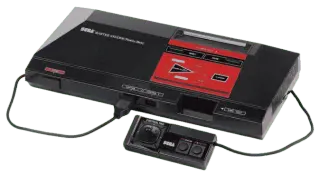
SMS
Sonic the Hedgehog
The 8-bit Sega Master System version of Sonic's debut adventure, developed separately from the Genesis/Mega Drive classic. While sharing the same premise of stopping Dr. Robotnik's animal-roboticizing plans, this version features completely unique level designs tailored to the 8-bit hardware's capabilities.
Release Date
January 1, 1991
Players
1
Region
US
ROM Size
143 KB
Share this game
Story
Sega's efforts had been stymied by the dominance of Nintendo ; the Genesis did not have a large install base and Nintendo did not take Sega seriously as a competitor. : 414 Sega of America CEO Michael Katz attempted to challenge Nintendo with the " Genesis does what Nintendon't " marketing campaign and by collaborating with athletes and celebrities to create games. : 405–406 These efforts did not break Nintendo's dominance, and Katz was replaced by Tom Kalinske , formerly of Mattel . : 423–424 Sega president Hayao Nakayama decided Sega needed a flagship series and mascot to compete with Nintendo's Mario franchise . Nintendo had recently released Super Mario Bros. 3 , at the time the bestselling video game ever. Sega's strategy had been based on porting its successful arcade games to the Genesis; however, Nakayama recognized that Sega needed a star character in a game that could demonstrate the power of the Genesis's hardware. An internal contest was held to determine a flagship game, with a focus on the American audience. Among the teams working on proposals were artist Naoto Ohshima and programmer Yuji Naka . : 20–33, 96–101 The gameplay of Sonic the Hedgehog (1991) originated with a tech demo created by Naka, who had developed an algorithm that allowed a sprite to move smoothly on a curve by determining its position with a dot matrix . Naka's prototype was a platform game that involved a fast-moving character rolling in a ball through a long winding tube. Sega management accepted the duo's project, and they were joined by designer Hirokazu Yasuhara . : 20–33, 96–101 After Yasuhara joined Naka and Ohshima, their focus shifted to the protagonist, who Sega hoped could become its mascot. : 20–33, 96–101 The protagonist was initially a rabbit able to grasp objects with prehensile ears, but the concept proved too complex for the hardware. The team moved on to animals that could roll into a ball, and eventually settled on Sonic , a teal hedgehog created by Ohshima. Naka's prototype was expanded with Ohshima's character design and levels conceived by Yasuhara. Sonic's color was chosen to match Sega's cobalt blue logo, and his red and white shoes were inspired by the cover of Michael Jackson 's 1987 album Bad . His personality was based on then- Governor of Arkansas Bill Clinton 's "can-do" attitude. The antagonist, Doctor Eggman , was another character Ohshima had designed for the contest. The team thought the abandoned design was excellent and redesigned it as a villain. The team took the name Sonic Team for the game's release. Sonic's first appearance came in Sega AM3 's racing game Rad Mobile (1991) five months before the release of Sonic the Hedgehog , as an ornament hanging from the driver's rearview mirror. The Sonic developers let AM3 use Sonic because they were interested in making him visible to the public. According to Mark Cerny , who worked in Tokyo as an intermediary between the Japanese and American Sega offices, the American staff felt that Sonic had no appeal. Although Katz was certain that Sonic would not be popular with American children, Kalinske arranged to place Sonic the Hedgehog as the pack-in game with the Genesis. Featuring speedy gameplay, Sonic the Hedgehog received critical acclaim. It greatly increased the popularity of the Sega Genesis in North America, credited with helping Sega gain 65% of the market share against Nintendo.
Gameplay Systems
Examples of gameplay in Sonic the Hedgehog 2 (1992) and Sonic Unleashed (2008), illustrating some of the core game mechanics of 2D and 3D Sonic games The Sonic series is characterized by speed-based platforming gameplay. Controlling the player character , the player navigates a series of levels at high speeds while jumping between platforms, fighting enemies and bosses , and avoiding obstacles. The series contains both 2D and 3D games. 2D entries generally feature simple, pinball-like gameplay —with jumping and attacking controlled by a single button —and branching level paths that require memorization to maintain speed. Meanwhile, 3D entries tend to be more linear in design, feature various level objectives, different movesets, and allow players to upgrade and customize the playable character. Games since Sonic Unleashed have blended 2D and 3D gameplay, with the camera shifting between side-scrolling and third-person perspectives. One distinctive game mechanic of Sonic games are collectible golden rings spread throughout levels, which act as a form of health . Players possessing rings can survive upon sustaining damage, but the rings are scattered and the player has a short amount of time to re-collect some of them before they disappear. Collecting 100 rings usually rewards the player an extra life . Rings have other uses in certain games, such as currency in Sonic '06 , restoring health bars in Sonic Unleashed , or improving statistics in Sonic Riders . Levels in Sonic games feature elements such as slopes, bottomless pits, and vertical loops . Springs, springboards, and dash panels are scattered throughout and catapult the player at high speeds in a particular direction. Players' progress in levels is saved through passing checkpoints . Checkpoints serve other uses in various games, such as entering bonus stages. Some settings, particularly Green Hill Zone , recur throughout the series. The series contains numerous power-ups, which are held in boxes that appear throughout levels. An icon indicates what it contains, and the player releases the item by destroying the box. Common items in boxes include rings, a shield, invincibility, high speed, and extra lives. Sonic Colors introduces the Wisps, a race of extraterrestrial creatures that act as power-ups. Each Wisp has its own special ability corresponding to its color; for instance, yellow Wisps allow players to drill underground and find otherwise inaccessible areas. Since Sonic Rush , most Sonic games have featured "boosting", a mechanic that immediately propels Sonic forward at top speed when activated. While boosting, Sonic can smash through objects, destroy enemies instantly, or access different level paths. This requires players to react to forthcoming obstacles quickly; Sonic Unleashed introduced side-stepping and drifting maneuvers to allow players to maintain speed. Boosting is limited by a gauge that the player can fill with rings or Wisps. In most Sonic games, the goal is to collect the Chaos Emeralds; the player is required to collect them all to defeat Eggman and achieve the games' good endings . Sonic games that do not feature the Chaos Emeralds, such as Sonic CD , feature different collectibles that otherwise function the same. Players find the Emeralds by entering portals, opening portals using 50 rings, or scouting them within levels themselves. Sometimes, the Emeralds are collected automatically as the story progresses. By collecting the Emeralds, players are rewarded with their characters' "Super" form and can activate it by collecting 50 rings in a stage. The Super transformations grant the player character more speed, a farther jump, and invincibility, but their ring count drains by the second; the transformation lasts until all the rings have been used. Some games require the player to collect all the Chaos Emeralds to reach the final boss. Sonic games often share basic gameplay, but some have game mechanics that distinguish them from others. For instance, Knuckles' Chaotix is similar to previous entries in the series, but introduces a partner system whereby the player is connected to another character via a tether; the tether behaves like a rubber band and must be used to maneuver the characters. Sonic Unleashed introduces the Werehog, a beat 'em up gameplay style in which Sonic transforms into a werewolf-like beast and must fight enemies using brute strength. Both the Sonic Storybook games feature unique concepts: Secret Rings is controlled exclusively using the Wii Remote's motion detection, while Black Knight incorporates hack and slash gameplay. While some games feature Sonic as the only playable character, others feature multiple, who have alternate movesets and storylines. For instance, in Sonic & Knuckles , Knuckles goes through the same levels as Sonic, but his story is different, he explores different parts of the levels, and certain areas are more difficult. Many Sonic games contain multiplayer and cooperative gameplay , beginning with Sonic the Hedgehog 2 . In some games, if the player chooses to control Sonic and Tails together, a second player can join at any time and control Tails separately. Sonic games also feature a split-screen competitive mode in which two players race to the end of the stage.
Sales & Commercial Performance
Total Copies Sold
89 million copies
Total Revenue
$5 billion
Media Reviews
IGN
2
Edge
2
Eurogamer
3
Some information sourced from Wikipedia, available under CC BY-SA 3.0.