
GBA
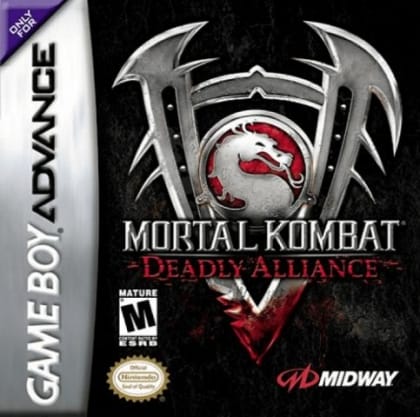
Mortal Kombat: Deadly Alliance
The first Mortal Kombat game for GBA featuring 3D-rendered fighters with unique fighting styles and fatalities. Quan Chi and Shang Tsung form an alliance to conquer Earthrealm.
Share this game
Story
At the end of Mortal Kombat 4 (which is Scorpion 's canon ending), Quan Chi revealed himself to be the murderer of Scorpion's family and clan, before attempting to send him back to the Netherrealm. Scorpion, fueled with homicidal rage, grabbed Quan Chi at the last minute, taking the sorcerer with him. In the opening intro to Deadly Alliance , it is revealed that Quan Chi was able to escape the Netherrealm, using the amulet he had stolen from Shinnok . He appears in a tomb containing several mummified remains and an ancient runestone, which reveals that the remains are the "undefeatable" army of the long-forgotten ruler of Outworld, known simply as the "Dragon King". Learning that it can be revived, Quan Chi allies with Shang Tsung , offering him an endless supply of souls in return for his transplanting the souls of defeated warriors into the army. The two work together to defeat and kill Shao Kahn and Liu Kang , the two greatest threats to their plans. Unable to interfere as an Elder God, Raiden surrenders his status after realizing that, should the alliance be victorious, Earthrealm is doomed. In Deadly Alliance , the player receives information concerning the characters' backstories and their relationships with one another, mainly during Konquest mode, but also by way of biographies that can be obtained in the Krypt. The game occurs in a science fantasy setting, with most events occurring in the fictional realms of the Mortal Kombat series. The story begins in the Netherealm (although this is not a playable level), and later switches to Outworld, Edenia, and eventually Earthrealm. To fully understand the plot of Deadly Alliance , the player must complete the Konquest mode and the Arcade mode. Completing the Arcade mode unlocks endings for each character, but only a few endings or parts of them are considered part of the continuity of the Mortal Kombat storyline. Some endings even contradict one another. What happened to the characters was only revealed in the sequel Mortal Kombat: Deception , making Deadly Alliance the first game in the series to have an in-continuity ending that involves the heroes losing and the villains emerging victorious.
Gameplay Systems
Like all the Mortal Kombat games, Deadly Alliance focuses heavily on its fighting modes. The gameplay is completely different from that of previous entries in the franchise. Each character now possesses three individual fighting styles, generally two hand-to-hand styles and one weapon style (except for Blaze and Mokap, who received three hand-to-hand styles and no weapon style) which players can switch between with the push of a button. In previous games, aside from "dial-a- combos ", all the characters fought virtually identically, with only special moves to differentiate them. The number of special moves per character (usable in any fighting style) has also been reduced, varying only from two to four for most, thus forcing the player to use the improved fighting system. The characters can no longer run, and there is no run meter. However, while still limited to only moving into the background and foreground, movement in the third dimension is much easier and can be used continuously (in Mortal Kombat 4 , sidestepping was mapped to two different buttons and could be performed at a rate of about one second). To prevent fighters from leaving the arena, invisible boundaries appear when a fighter is knocked against the edge. Character models became more realistic. Flesh will move or jiggle on a character as he or she moves around. Environmental interaction is present, but infrequent. Several levels include obstacles—such as pillars or statues—that can be shattered to damage an opponent standing near one. There is just one Fatality per character, while the previous games included many ways to finish the opponent. Like Mortal Kombat X (until the XL patch added them to Mortal Kombat X ) and Mortal Kombat 1 , the game does not include Stage Fatalities. However, the Acid Bath level still possesses special acid-vomiting statues called Acid Buddhas that do damage directly to fighters that stray too close to them. Deadly Alliance introduces the Konquest mode, which expands on the storyline and acts as a tutorial for each character. The Konquest mode consists of a series of missions that are completed by each of the characters. In between each sequence, a video of a monk moving between various locations on the path of Konquest is shown, but this has no actual bearing on the gameplay itself other than to simulate the sense of a journey. After completing eight initial " kombat tasks" with Sub-Zero , the player is instructed to complete a specific set of tasks with each character, which vary from performing difficult combos to defeating opponents. Each series comes with text instructions, including a basic storyline that delves further into each character's background and motives. Blaze and Mokap can only be unlocked by completing all stages of konquest . Upon completing each mission (of a starting difficulty for each character that increases per mission), the player is rewarded with many " koins " that act as the in-game currency to open koffins in the krypt and unlock secrets in the game. The krypt is a feature in which the player can buy extras with koins earned in regular play and konquest mode. The krypt consists of 676 " koffins " arranged in a square format with each designated alphabetically by a two-letter designation (AA–ZZ). The koffins are filled with many secrets and unlockables. Each koffin has a different designated price, listed in a number (anywhere from 1 up to the thousands) and type (Gold, Ruby, Sapphire, Jade, Onyx, and Platinum) of koins that it would cost to open the koffin . The Krypt includes unlockable characters, arenas, and alternative costumes. Also included among the koffins are various videos, images, concept sketches, and the entire Mortal Kombat Collector's Edition comic book. Some koffins contained koins that could be used towards other koffins , others contained hints as to where other items were located, and others were even empty. Test Your Might , the original minigame of the Mortal Kombat series, returns for the first time since the original game; a variation, Test Your Sight, is also included. In Test Your Sight, the character stands in front of a set of cups, and the game shows the player which cup contains the Mortal Kombat logo icon. The cups then move randomly; by the end, one must select the cup containing the icon. As the player progresses through the minigame, the number of cups increases, as does the speed at which the cups move. At higher levels, the camera would even move to make it more difficult for the player to keep track of the movement of the icon. Succeeding at both Test Your Might and Test Your Sight rewards the player with koins . The GBA -only Mortal Kombat: Tournament Edition adds three modes: Survival, Tag Team and Practice, and weapon Fatalities. Although both of the GBA versions feature 2D sprites , Tournament Edition was the first portable Mortal Kombat game to feature 3D style gameplay.
Awards & Honors
Best Brawl award
Sales & Commercial Performance
Total Copies Sold
2 million copies
Media Reviews
IGN
2
GameSpot
2
Electronic Gaming Monthly
2
Some information sourced from Wikipedia, available under CC BY-SA 3.0.