
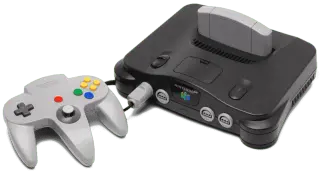
N64
Mario Kart 64
The definitive 3D kart racing experience. Battle with iconic items across 16 dynamic tracks in 4-player split-screen mayhem.
Share this game
Gameplay Systems
The player controls one of eight Mario franchise characters and races opponents in karts around tracks based on locales from the Super Mario platform games. The game's 16 courses are populated with obstacles to slow the player down, shortcuts letting the player skip sections, and boxes labeled with question marks which give the player a random item based on elements from the Super Mario series. Items can be either power-ups, such as giving the player a speed boost, or offensive, such as causing an opponent to spin out . The player can also drift around corners or enter an opponent's slipstream to receive a speed boost. Playable characters are divided into three weight classes which determine characteristics such as speed, acceleration, and handling. Princess Peach , Toad , and Yoshi are lightweights; Luigi and Mario are middleweights; and Bowser , Donkey Kong , and Wario are heavyweights. There are three difficulty levels based on engine classes—50 cc , 100cc, or 150cc—with the harder difficulties' more powerful engine classes providing increased maximum speeds and control difficulty. There are two single-player game mode options in Mario Kart 64 : Grand Prix (GP) and Time Trials . Time Trials is a solely single-player mode, and GP can be played in single-player or with two players. In GP, the game's main mode, the player races seven computer opponents (or six if playing in two-player mode) in one of four "cups" consisting of four tracks, with the objective of achieving the highest points across all four three-lap races. The player must race on every track in the cup, and points are given out at the end of each race based on position—nine for first place, six for second, three for third, and one for fourth. The player must come in at least fourth place in each race to continue racing for a trophy. Achieving the maximum number of points (i.e., winning all four races) on all cups in the 150cc difficulty unlocks a "mirror" mode in which all tracks are flipped left-to-right. In Time Trials, the player races on any of the 16 tracks with the aim of achieving the lowest time across three laps. There are no opponents or items on the track; the player is given three speed boosts to use across the whole race. The player can race against another player's time by sharing " ghost " data using the Controller Pak , a memory card that plugs into the back of the Nintendo 64 (N64) controller . Three local multiplayer modes are present in Mario Kart 64 : GP, Versus (VS), and Battle. The game utilises a split screen to display each player's gameplay. GP is unchanged from its single-player version, but allows for two players. In VS mode, two to four players race around any track without computer opponents. Battle mode sees two to four players compete in one of four arenas rather than tracks. The player begins with three balloons over their character, with the objective of popping other players' balloons using items. Players are knocked out upon losing all their balloons—though can control a bomb with wheels to attack remaining players afterwards—and the winner is whoever remains the last man standing .
Sales & Commercial Performance
Total Copies Sold
9.87 million copies
Media Reviews
IGN
64
GameSpot
6.4/10
Famitsu
9/10
Edge
8/10
Game Informer
9.25/10
Electronic Gaming Monthly
9.5/10
Some information sourced from Wikipedia, available under CC BY-SA 3.0.