
GBA
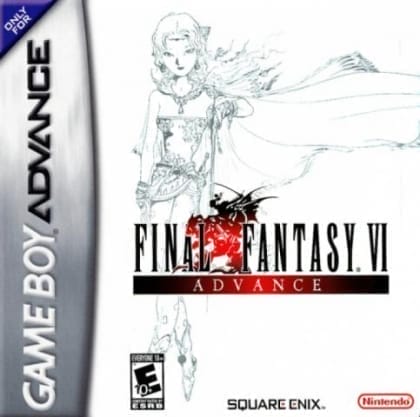
Final Fantasy VI Advance
The definitive portable version of the SNES classic, featuring enhanced graphics, four new Espers, and the Dragon's Den dungeon. Regarded as one of the greatest RPGs of all time.
Share this game
Story
Setting Instead of the strictly medieval fantasy settings featured in previous Final Fantasy titles, Final Fantasy VI is set in a world with deliberately more industrial and mechanical design elements; developers described a setting where machinery and magic coexist. Opera and the fine arts serve as recurring motifs—most notably the opera sequence—documented in developer interviews and later remaster materials. During the first half of the game, the planet is referred to as the World of Balance, and is divided into three lush continents. The northern continent is punctuated by a series of mountain ranges, the southern continent has been mostly subjugated by the cruel Gestahl Empire, and the eastern continent is home to the Veldt, a massive wilderness inhabited by monsters from all over the world. An apocalyptic event mid-game transforms the planet into the World of Ruin; its withering landmasses are fractured into numerous islands surrounding a larger continent. The game alludes to a conflict known as the "War of the Magi", which occurred one thousand years prior to the beginning of the game. In this conflict, three quarreling entities known as the "Warring Triad" used innocent humans as soldiers by transforming them into enslaved magical beings called Espers. The Triad realized their wrongdoings; they freed the espers and sealed their own powers inside three stone statues. As a precaution, the espers sealed off both the statues and themselves from the realm of humans. The concept of magic gradually faded to myth as mankind built a society extolling science and technology. At the game's opening, the Empire has taken advantage of the weakening barrier between the human and esper domains, capturing several espers in the process. Using these espers as a power source, the Empire has created "Magitek", a craft that combines magic with machinery (including mechanical infantry ) and infuses humans with magical powers. The Empire is opposed by the Returners, a rebel organization seeking to free the subjugated lands.
Gameplay Systems
Like previous installments, Final Fantasy VI consists of four basic modes of gameplay : an overworld map, town and dungeon field maps, a battle screen, and a menu screen. The overworld map is a scaled-down version of the game's world, which the player uses to direct characters to various locations. As with most games in the series, the three primary means of travel across the overworld are by foot, chocobo , and airship . With a few plot-driven exceptions, enemies are randomly encountered on field maps and on the overworld when traveling by foot. The menu screen is where the player makes such decisions as which characters will be in the traveling party, which equipment they wield, the magic they learn, and the configuration of the gameplay. It is also used to track experience points and levels . The game's plot develops as the player progresses through towns and dungeons. Town citizens will offer helpful information, and some residents own item or equipment shops. Later in the game, visiting certain towns will activate side-quests . Dungeons appear as a variety of areas, including caves, forests, and buildings. These dungeons often have treasure chests containing rare items that are not available in most stores. Dungeons may feature puzzles and mazes, with some dungeons requiring the player to divide the characters into multiple parties which must work together to advance through the dungeon. Combat Combat in Final Fantasy VI is menu -based, in which the player selects an action from a list of such options as Fight, Magic, and Item. A maximum of four characters may be used in battles, which are based on the series' traditional Active Time Battle (ATB) system, first featured in Final Fantasy IV . Under this system, each character has an action bar that replenishes itself at a rate dependent on their speed statistic . When a character's action bar is filled, the player may assign an action. In addition to standard battle techniques, each character possesses a unique special ability. For example, Locke possesses the ability to steal items from enemies, while Celes' Runic ability allows her to absorb most magical attacks cast until her next turn. Another element is the Desperation Attack, a powerful attack substitution that occasionally appears when a character's health is low. Similar features appear in later Final Fantasy titles under a variety of different names, including Limit Breaks, Trances, and Overdrives. Characters are rewarded for victorious battles with experience points and money, called gil ( Gold Piece (GP) in the original North American localization). When characters attain a certain number of experience points, they gain a level, which increases their statistics. An additional player may play during battle scenarios, with control of individual characters assigned from the configuration menu.
Sales & Commercial Performance
Total Copies Sold
2.55 million copies
Media Reviews
Famitsu
9/10
Edge
8/10
Game Informer
9.5/10
Electronic Gaming Monthly
9/10
Nintendo Power
1997
Some information sourced from Wikipedia, available under CC BY-SA 3.0.