GBA
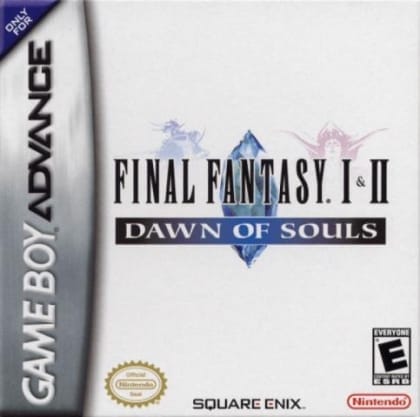
Final Fantasy I & II Advance
Final Fantasy I & II Advance combines enhanced versions of the first two Final Fantasy games for Game Boy Advance. Featuring updated graphics, new dungeons, and quality-of-life improvements, this compilation preserves the classic turn-based combat while adding content from later remakes like the Soul of Chaos and Arcane Labyrinths.
Share this game
Story
Setting Final Fantasy takes place in a fantasy world with three large continents. The elemental powers of this world are determined by the state of four crystals, each governing one of the four classical elements : earth, fire, water, and wind. The world of Final Fantasy is inhabited by numerous races, including humans, elves, dwarves, mermaids, dragons, and robots. Most non-human races have only one "town" in the game, although individuals are sometimes found in human towns or other areas as well. Four hundred years prior to the start of the game, the Lefeinish people, who used the Power of Wind to craft airships and a giant space station (called the Floating Castle in the game), watched their country decline as the Wind crystal went dark. Two hundred years later, violent storms sank a massive shrine that served as the center of an ocean-based civilization, and the Water crystal went dark. The Earth crystal and the Fire crystal followed, plaguing the earth with raging wildfires, and devastating the agricultural town of Melmond as the plains and vegetation decayed. Some time later, the sage Lukahn tells of a prophecy that four Light Warriors will come to save the world in a time of darkness.
Gameplay Systems
Final Fantasy has four basic game modes: an overworld map, town and dungeon maps, a battle screen, and a menu screen. The overworld map is a scaled-down version of the game's fictional world, which the player uses to direct characters to various locations. The primary means of travel across the overworld is by foot; a ship, a canoe, and an airship become available as the player progresses. With the exception of some battles in preset locations or with bosses , enemies are randomly encountered on field maps and on the overworld map when traveling by foot, canoe, or ship, and must either be fought or fled from. The game's plot develops as the player progresses through towns and dungeons. Some town citizens offer helpful information, while others own shops that sell items or equipment. Dungeons appear in areas that include forests, caves, mountains, swamps, underwater caverns, and buildings. Dungeons often have treasure chests containing rare items that are not available in most stores. The game's menu screen allows the player to keep track of their experience points and levels, to choose which equipment their characters wield, and to use items and magic. A character's most basic attribute is their level, which can range from one to fifty, and is determined by the character's amount of experience. Gaining a level increases the character's attributes, such as their maximum hit points (HP), which represents a character's remaining health; a character dies when they reach zero HP. Characters gain experience points by winning battles. Combat in Final Fantasy is menu-based: the player selects an action from a list of options such as Attack, Magic, and Item. Battles are turn-based and continue until either side flees or is defeated. If the player's party wins, each character will gain not only experience but also money, which is known as Gil in the Final Fantasy universe; if it flees, it will be returned to the map screen; and if every character in the party dies, the game will be over and all unsaved progress will be lost. Final Fantasy was the first game to show the player's characters on the right side of the screen and the enemies on the left side of the screen, as opposed to a first-person view . The player begins the game by choosing four characters to form a party and is locked into that choice for the duration of the game. Each character has an "occupation", or character class , with different attributes and abilities that are either innate or can be acquired. There are six classes: Fighter, Thief, Black Belt, Red Mage, White Mage, and Black Mage. Later in the game, the player has the option to have each character undergo a "class upgrade"; whereby their sprite portraits mature, and some classes gain the ability to use weapons and magic that they previously could not use. The game contains a variety of weapons, armor, and items that can be bought or found to make the characters more powerful in combat. Each character has eight inventory slots, with four to hold weapons and four to hold armor. Each character class has restrictions on what weapons and armor it may use. Some weapons and armor are magical; if used during combat, they will cast spells. Other magical artifacts provide protection, such as from certain spells. At shops, the characters can buy items to help themselves recover while they are traveling. Items available include potions, which heal the characters or remove ailments like poison or petrification; Tents and Cabins, which can be used on the world map to heal the player and optionally save the game; and Houses, which also recover the party's magic after saving. Special items may be gained by doing quests . Magic is a common ability in the game, and several character classes use it. Spells are divided into two groups: White, which is defensive and healing, and Black, which is debilitating and destructive. Magic can be bought from White and Black magic shops and assigned to characters whose occupation allows them to use it. Spells are classified by a level between one and eight, with four White and four Black spells per level. Each character may learn only three spells per level. White and Black Mages can potentially learn any of their respective spells, while Red Mages, the Ninja, and the Knight cannot use most high-level magic.
Sales & Commercial Performance
Total Copies Sold
1.3 million copies
Media Reviews
IGN
8.6/10
GameSpot
6.5/10
Famitsu
34/40
Nintendo Power
200
Some information sourced from Wikipedia, available under CC BY-SA 3.0.