FDS
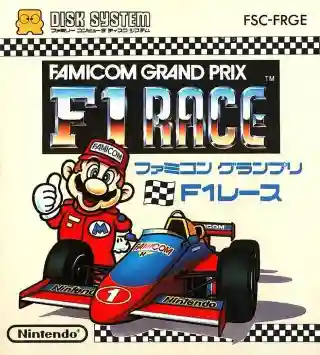
Famicom Grand Prix: F1 Race
Nintendo's official Formula 1 racing game for the Famicom Disk System. Features 8 F1 teams and circuits with battery backup for saving progress. The first F1-licensed game on a Nintendo console.
Share this game
Story
Super Mario Kart The idea for the game stemmed from the fact that the high- speed racing game F-Zero lacked multiplayer. However, hardware limitations would cause the size of tracks in the game to be much smaller than they were in F-Zero due to the hardware resources taken up by multiplayer racing, making the track design more focused on turns than maintaining speed.
Gameplay Systems
This section needs additional citations for verification . Please help improve this article by adding citations to reliable sources in this section. Unsourced material may be challenged and removed. ( May 2025 ) ( Learn how and when to remove this message ) In the Mario Kart series, players compete in go-kart races , controlling one of a selection of Mario characters. Up to 24 characters can compete in each race (varying per game). Players can perform driving techniques during the race such as rocket starts, slipstreaming , drifting and mini-turbos. Gameplay is enhanced by power-up items obtained by driving into item boxes laid out on the course. These power-ups vary across games in the series, but generally include Mushrooms to give players a speed boost, Red/Green Shells to be thrown at opponents, Banana Peels and hazards such as Fake Item Boxes. The game selects an item based on the player's current position in the race, utilising a mechanism known as rubber banding . For example, players lagging far behind may receive more powerful items such as Bullet Bills , which give the player invincibility while auto-piloting them forward at great speed, while the leader of a race may only receive small defensive items, such as Shells or Bananas. This gameplay mechanism allows other racers a realistic chance to catch up to the leading racer. In the original game, Super Mario Kart , the player takes control one of the eight Mario series characters, each with differing capabilities. In single player mode, players can race against computer-controlled characters in 4 multi-race cups consisting of 20 tracks (5 in each cup) over three difficulty levels (50cc, 100cc and 150cc). Alternatively, players can race against the clock in a Time Trial mode. In multiplayer mode, two players can simultaneously take part in the cups or can race against each other one-on-one in Match Race mode. In a third multiplayer mode – Battle Mode – the aim is to defeat the other players by attacking them with power-ups, destroying balloons which surround each kart. Each new game has introduced new gameplay elements, such as new circuits, items, modes, and playable characters. Mario Kart 64 introduced 3D graphics , 4-player racing, mini turbos to more easily execute drift boosts, slipstreaming, and item dangling (the ability to hold bananas and shells to defend against projectiles and hold a reserve item as well), alongside the removal of coins. It introduced several items, including the Fake Item Box, the Golden Mushroom, and the Spiny Shell . In addition to the three Grand Prix engine classes, Extra Mode (known in later games as Mirror Mode) was introduced, in which all tracks are flipped laterally. When playing Battle Mode with three or more players, when a player is defeated they turn into a "Mini Bomb Kart", where they can try and pop another player's balloons. Mario Kart: Super Circuit returns to the Mode 7 gameplay style found in Super Mario Kart . Multiplayer in Super Circuit is done via GBA Link Cable . The game allows multiplayer with only one Game Pak , although if played this way the game includes various restrictions, such as a limited course count and players only being allowed to play as Yoshis . Super Circuit introduces a new mode called Free Run , which allows the player to play any course with CPU. Battle mode appears as it did in 64 , with Mini Bomb Karts being replaced by Bob-ombs that respawn once exploded. Mario Kart: Double Dash!! returns to the 3D format that originated in Mario Kart 64 . New feature to the game include double-occupied karts, a 2-player Co-op mode where one player drives while the other uses items, and also LAN play, which allows up to 16 people to play. It introduced a revamped Spiny Shell that leaves an area of effect explosion, and character exclusive items (known in the game as Special Items). It also introduced new alternate battle modes: "Shine Thief", where players fight over obtaining a Shine Sprite from Super Mario Sunshine (2002) before a timer runs out, and "Bob-omb Blast" where players throw Bob-ombs to collect or steal points from each other. In Balloon battle, players no longer turn into Bob-ombs when defeated. Mario Kart DS featured dual-screen play to take advantage of the system's capabilities. It introduced custom emblems, as well as Online play via the now defunct Nintendo Wi-Fi Connection , a mission mode, and returning courses as a main feature. It also returned to the single item and racer format. New playable characters included Dry Bones , R.O.B. , and Shy Guy (who was exclusive to DS Download Play ). It also introduced a new battle mode in "Shine Runners" (not to be confused with the aforementioned "Shine Thief") where players try to collect enough Shine Sprites before a timer runs out to avoid being eliminated. Mario Kart Wii introduced motion controls as a headlining new feature alongside the Wii Wheel accessory. It also introduced the ability to perform mid-air tricks, and bikes as a second vehicle type. The amount of racers that could be in a race was raised from 8 to 12. It introduced three new items: the Mega Mushroom , the Thundercloud, and the POW Block . It also introduced a new battle mode titled "Coin Runners" (not to be confused with "Shine Runners"), where players try to collect as many coins as they can before time runs up. The rules of Balloon Battle are now changed, with the focus now being on getting points by popping other player's balloons before a time limit expires, with players now respawning once they run out of balloons. Mario Kart 7 featured stereoscopic 3D graphics and the return of dual screen functionality. It introduced gliders and submersible karts, a first-person perspective, and full kart customization. It also re-introduced Coins in regular races for a small speed boost, though they are also now used to unlock kart parts. Mario Kart 8 introduced the 200cc engine class, anti-gravity racing, a third vehicle type in ATVs , download
Sales & Commercial Performance
Total Copies Sold
206 million copies
Media Reviews
IGN
1
GameSpot
1
Edge
2
Nintendo Power
8.76
Some information sourced from Wikipedia, available under CC BY-SA 3.0.